Arc Flash: What It Is, What Causes It, and How to Prevent It
An arc flash is one of the most violent events in electrical work. In a fraction of a second it releases blinding light, intense heat, molten metal and a pressure wave, often at equipment that looked perfectly normal a moment earlier. Electricians, maintenance technicians and facility managers all face it, and so does anyone who opens a panel. This guide explains what an arc flash is, why it happens, how hot it gets and how it injures people. It then covers how engineers measure, label and design out the hazard using NFPA 70E, OSHA rules and IEEE 1584. It is written for anyone responsible for arc flash safety on site.
Key Takeaways
- An arc flash is the light and heat released when electric current jumps through the air between conductors, or from a conductor to ground.
- Arc temperatures can exceed 35,000 °F (19,400 °C), nearly four times the temperature of the sun’s surface.
- Severity depends mostly on fault current, how long the arc lasts and how close you are. Voltage matters much less, so low voltage does not mean low risk.
- The arc flash boundary is the distance at which incident energy falls to 1.2 cal/cm², the onset of a second-degree burn.
- The most effective protection is to put equipment into an electrically safe work condition. Engineering controls come next, and PPE is the last line of defense.
What is an arc flash?
Arc flash definition: An arc flash is the sudden release of light and heat energy caused by an electric arc: current that leaves its intended path and flows through ionized air between phases, or from a phase to ground. The arc forms a plasma channel that can reach thousands of degrees within milliseconds. It keeps burning until an upstream protective device (a breaker or fuse) interrupts the fault.
The term covers the whole electrical arc flash event in everyday use. Strictly speaking, though, the “flash” is the thermal and light hazard. The pressure wave that follows is called the arc blast, and it is treated separately in safety planning (see arc flash vs arc blast below).
Arcing vs arc flash
Arcing is any discharge of current through air: the small spark when a switch opens, or the glow at a loose connection. An arcing fault is uncontrolled arcing between energized conductors. It becomes a dangerous arc flash when the power system can feed it enough current for long enough. A small arc on a light switch is harmless. The same physics at a 480 V switchboard fed by a large transformer can release enough energy to kill.
Can an arc flash happen at low voltage?
Yes. OSHA specifically warns that arcs on 120/208 V systems can burn skin, ignite clothing and cause serious or fatal injuries. Arc flash energy depends mostly on available current, arc duration and the worker’s distance from the arc, not on voltage alone. NFPA 70E’s work practices for energized work apply to exposed parts at 50 volts or more. Medium-voltage equipment (above 1,000 V) sustains arcs more easily, but most arc flash injuries happen on everyday low-voltage distribution equipment.
What causes an arc flash?
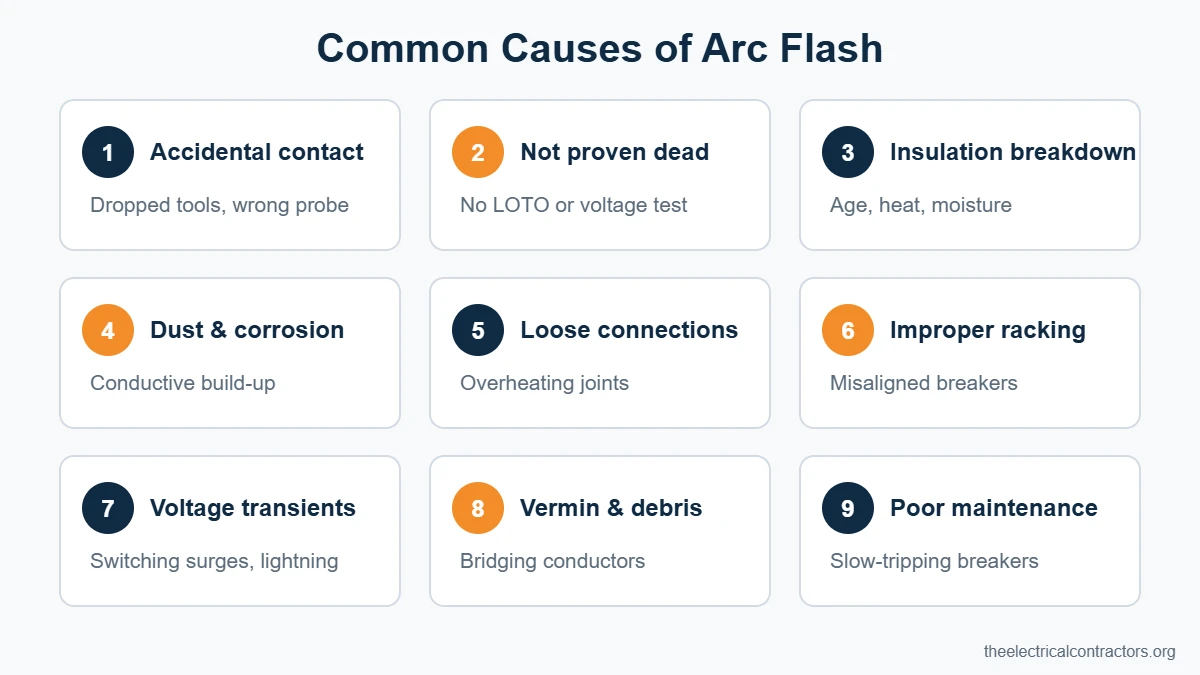
An arc flash starts when something lets current bridge the gap between conductors that should be insulated from each other. Common causes include:
- Accidental contact: dropped tools, loose hardware or a test probe touching the wrong surface inside a live enclosure.
- Working on equipment that is not proven dead: skipping absence-of-voltage testing or lockout/tagout. OSHA treats de-energized parts that are not locked or tagged out as energized.
- Insulation breakdown: ageing, overheating, moisture, contamination or mechanical damage to cables and busbar insulation.
- Dust, corrosion and condensation: conductive paths that build up over time inside poorly maintained or poorly sealed equipment.
- Loose or failing connections: high-resistance joints overheat and can start arcing.
- Improper installation or racking: misaligned breakers, incorrect parts, or racking breakers in or out with the door open.
- Voltage transients: switching surges and lightning, especially while measurements are being taken.
- Vermin and foreign objects: animals or debris bridging conductors.
- Poorly maintained protective devices: a breaker that trips late doesn’t cause the arc, but it greatly increases the energy released.
Why do arc flashes happen so often during maintenance? OSHA’s arc flash guidance points to the same answer: most incidents involve a person interacting with the equipment: opening covers, operating switches, testing or racking. Human activity provides the trigger, and the open enclosure provides the exposure.
How hot is an arc flash?
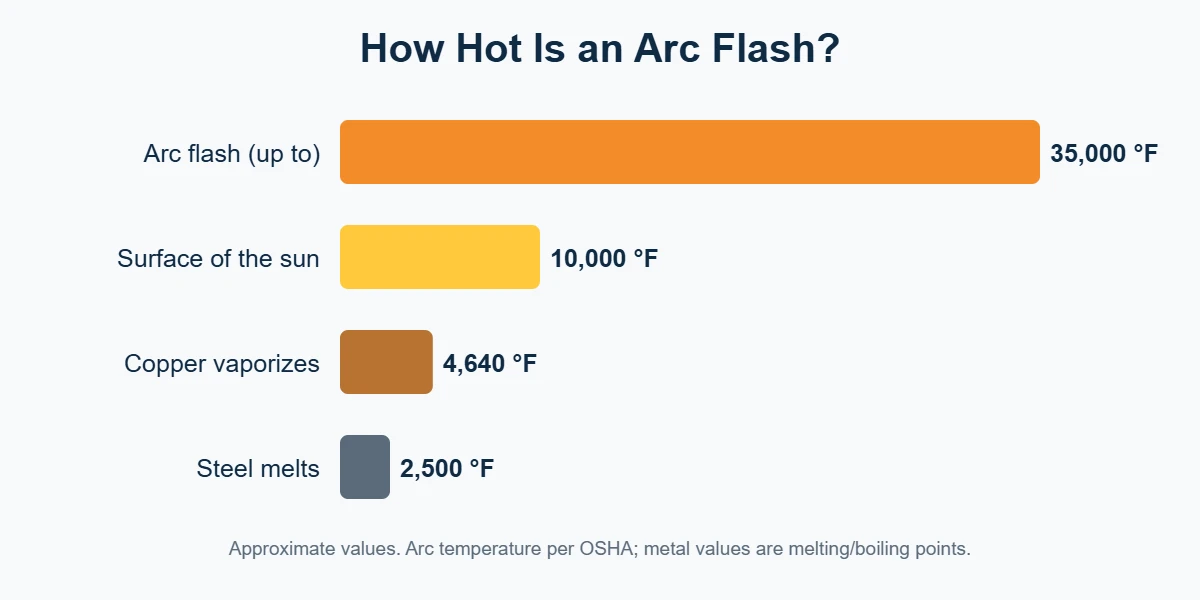
According to OSHA, the hot gas in an electric arc can exceed 35,000 °F (19,400 °C), nearly four times the temperature of the sun’s surface. At those temperatures copper and aluminium conductors vaporize instantly. Copper expands about 67,000 times in volume when it turns from solid to vapor, which is what drives the arc blast and throws molten metal droplets up to about 10 ft (3 m).
How long does an arc flash last?
An arc flash lasts until the upstream protective device clears the fault. That is usually a few cycles (tens of milliseconds) for a breaker tripping on its instantaneous setting, but it can be a second or more if the device has a time delay or the arcing current is too low to trip it quickly. Duration matters as much as current: incident energy rises in proportion to arcing time. That is why the speed of protective devices is central to arc flash engineering.
Arc flash vs arc blast
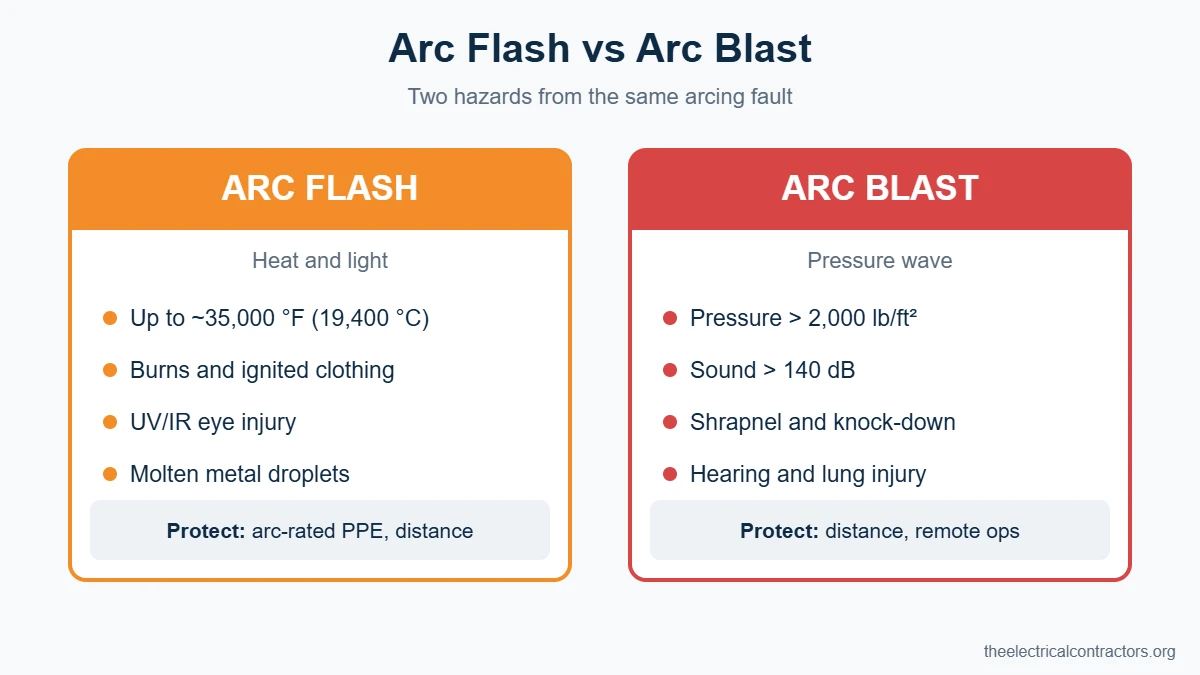
When comparing arc blast vs arc flash, the key point is that both come from the same arcing fault but injure people in different ways:
| Arc flash | Arc blast | |
|---|---|---|
| What it is | Light and thermal radiation from the arc | Pressure wave from rapidly expanding vaporized metal and superheated air |
| Main hazards | Burns, ignited clothing, eye damage from intense UV/IR light | Knock-down force, falls, hearing damage, flying shrapnel and molten metal, lung injury |
| Typical magnitude | Temperatures up to ~35,000 °F | Pressures that can exceed 2,000 lb/ft², sound above 160 dB, and shrapnel at over 700 mph |
| Protection | Arc-rated clothing and face/head protection sized to the incident energy | Distance, remote operation, arc-resistant equipment, hearing protection. Arc-rated PPE is not rated for blast. |
One related term: an electrical explosion is the everyday name for the combined event, the flash plus the blast.
Arc flash injuries and hazards
An estimate of five to ten arc flash explosions in the US every day is cited in OSHA’s 2024 arc flash guidance. Earlier OSHA injury data summarized in NFPA 70E (Informative Annex K) found that 75 percent of reported arc burn injuries were third-degree burns. The injuries are often life-changing:
Burns
Second- and third-degree burns are the most common arc flash injury. OSHA notes that most arc flash burns come from ignited clothing, not from the arc itself. Non-arc-rated synthetics such as nylon, polyester and spandex melt into the skin, and untreated cotton, wool and silk can ignite and keep burning. That is why NFPA 70E prohibits meltable fibers in underlayers worn beneath arc-rated clothing, and requires any jacket, rainwear or harness worn over it to be arc rated too.
Arc flash eyes: eye injuries from UV and IR light
The intense ultraviolet and infrared light can cause flash burns to the cornea, retinal damage and temporary or permanent loss of vision. Molten metal droplets add a penetrating-injury risk.
Hearing, lung and blast injuries
The NFPA 70E Handbook notes that eardrums can rupture at pressures as low as 720 lb/ft², lung damage begins at roughly 1,728 to 2,160 lb/ft², and even short exposure to 140 dB can cause permanent hearing damage. The blast can throw a worker across a room or off a ladder, and the metal-oxide smoke from vaporized copper is poisonous to inhale.
Arc flash deaths
Severe arc flash events can be fatal, either directly from burns and blast or from secondary falls and electric shock. Survivors often face months of burn treatment, skin grafts and rehabilitation, and the costs reach millions of dollars.
What determines the severity of an arc flash injury?
| Factor | Effect on severity |
|---|---|
| Available fault current | Higher current feeds a more energetic arc. |
| Arc duration (clearing time) | Incident energy rises roughly in proportion to how long the arc lasts. |
| Working distance | Energy falls off sharply with distance. Hands and face closest to the arc receive the most. |
| Equipment type and enclosure size | Enclosures focus energy toward the opening, toward the worker. |
| Electrode configuration and gap | IEEE 1584-2018 shows that conductor orientation strongly affects energy toward the worker. |
| Clothing and PPE | Flammable clothing turns a survivable exposure into a severe burn. |
Incident energy: how arc flash severity is measured
Engineers quantify arc flash severity as incident energy, the thermal energy that reaches a surface at a given working distance from the arc. It is expressed in calories per square centimetre (cal/cm²). For reference, 1.2 cal/cm² is roughly the exposure that causes the onset of a second-degree burn on bare skin.
Incident energy is calculated in an arc flash study, usually with the empirical models in IEEE 1584. The inputs come from the actual power system: utility fault contribution, transformer data, cable sizes and lengths, protective device settings, equipment type and working distances. The result is a site-specific value for each piece of equipment. That value then sets the arc flash boundary and the PPE required. Under NFPA 70E, incident energy is assessed at the working distance of the worker’s face and chest, and the analysis must account for the protective device’s clearing time and its condition of maintenance.
Arc flash boundary
NFPA 70E defines the arc flash boundary as the distance from a prospective arc source at which the incident energy equals 1.2 cal/cm² (5 J/cm²). Anyone inside that boundary without appropriate arc-rated PPE could receive a second-degree burn if an arc flash occurred. So if you are asking “what is an arc flash protection boundary?”, this is it: older editions of NFPA 70E called it the flash protection boundary.
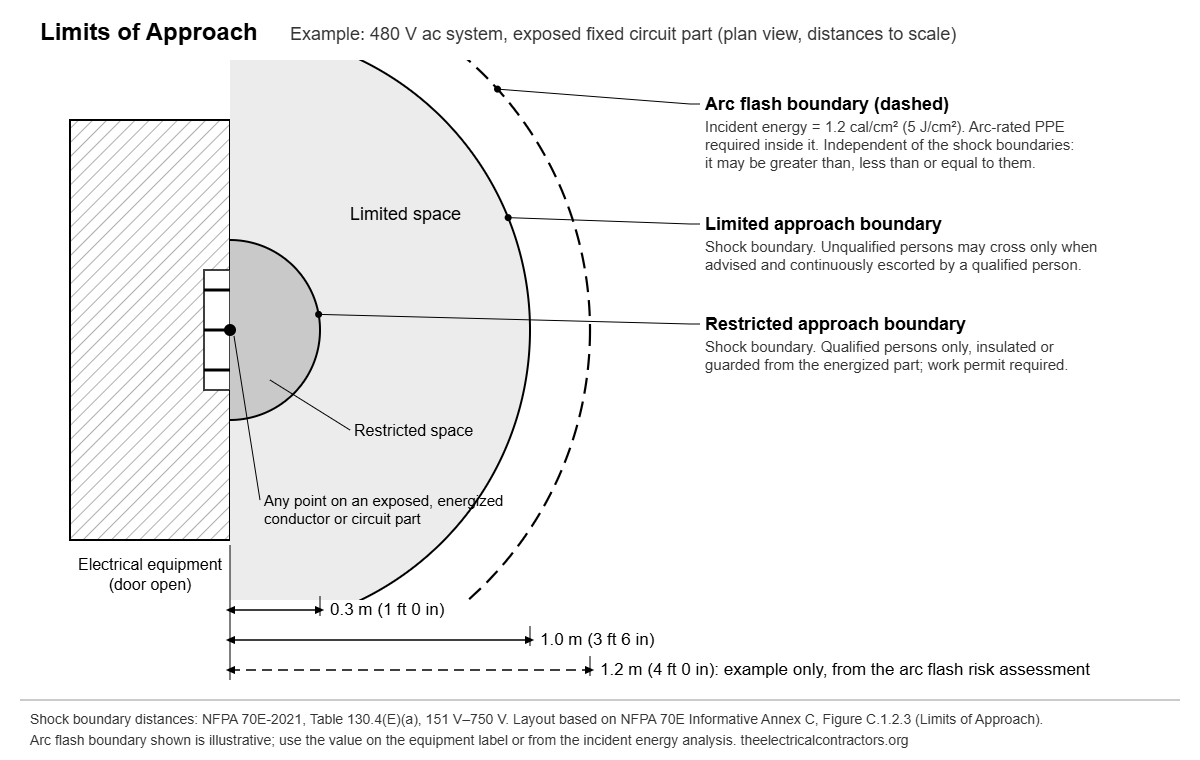
The arc flash boundary is separate from the two shock protection boundaries:
- Limited approach boundary: the approach limit for unqualified persons. They may cross it only when a qualified person has advised them of the hazards and continuously escorts them.
- Restricted approach boundary: the approach limit for qualified persons. It may be crossed only by a qualified person who is insulated or guarded from the energized parts (for example, with voltage-rated gloves and insulated tools), and work inside it requires an energized electrical work permit. Unqualified persons may never cross it.
How are arc flash and electric shock protection boundaries determined? Shock boundaries depend on system voltage and are read from NFPA 70E tables. For a 480 V ac system, NFPA 70E-2021 Table 130.4(E)(a) sets the limited approach boundary at 1.0 m (3 ft 6 in) to an exposed fixed circuit part and the restricted approach boundary at 0.3 m (1 ft 0 in) (see OSHA’s boundaries fact sheet). The arc flash boundary depends on incident energy, so it is calculated in an arc flash study or taken from the PPE category tables. NFPA 70E is explicit that the two are independent: the arc flash boundary may be greater than, less than or equal to the shock boundaries.
Arc flash PPE and PPE categories
Arc flash PPE is arc-rated (AR) clothing and equipment whose arc rating (often called the arc flash rating), in cal/cm², is the incident energy at which there is a 50 percent probability of the onset of a second-degree burn through the material (ATPV) or of the fabric breaking open (EBT), whichever is lower. NFPA 70E allows two ways to select it for a given piece of equipment, but not both on the same equipment:
- Incident energy analysis method: PPE is matched to the calculated incident energy at the working distance.
- Arc flash PPE category method: tables assign PPE Category 1 to 4 for common tasks and equipment, within stated limits on fault current and clearing time. The category tables must not be used to pick PPE from an incident energy calculation.
| PPE category | Minimum arc rating | Typical arc flash PPE |
|---|---|---|
| 1 | 4 cal/cm² | AR long-sleeve shirt and pants or AR coverall; AR face shield or arc flash suit hood; hard hat; safety glasses or goggles; hearing protection (ear canal inserts); heavy-duty leather, AR, or rubber insulating gloves with leather protectors |
| 2 | 8 cal/cm² | AR long-sleeve shirt and pants or AR coverall; arc flash suit hood, or AR face shield plus AR balaclava; hard hat; safety glasses or goggles; hearing protection; gloves as for Category 1; leather footwear |
| 3 | 25 cal/cm² | AR clothing with a system arc rating of at least 25 cal/cm² (e.g., arc flash suit jacket and pants, or coverall); arc flash suit hood; AR gloves or rubber insulating gloves with leather protectors; hard hat; safety glasses or goggles; hearing protection; leather footwear |
| 4 | 40 cal/cm² | As Category 3, with a system arc rating of at least 40 cal/cm² |
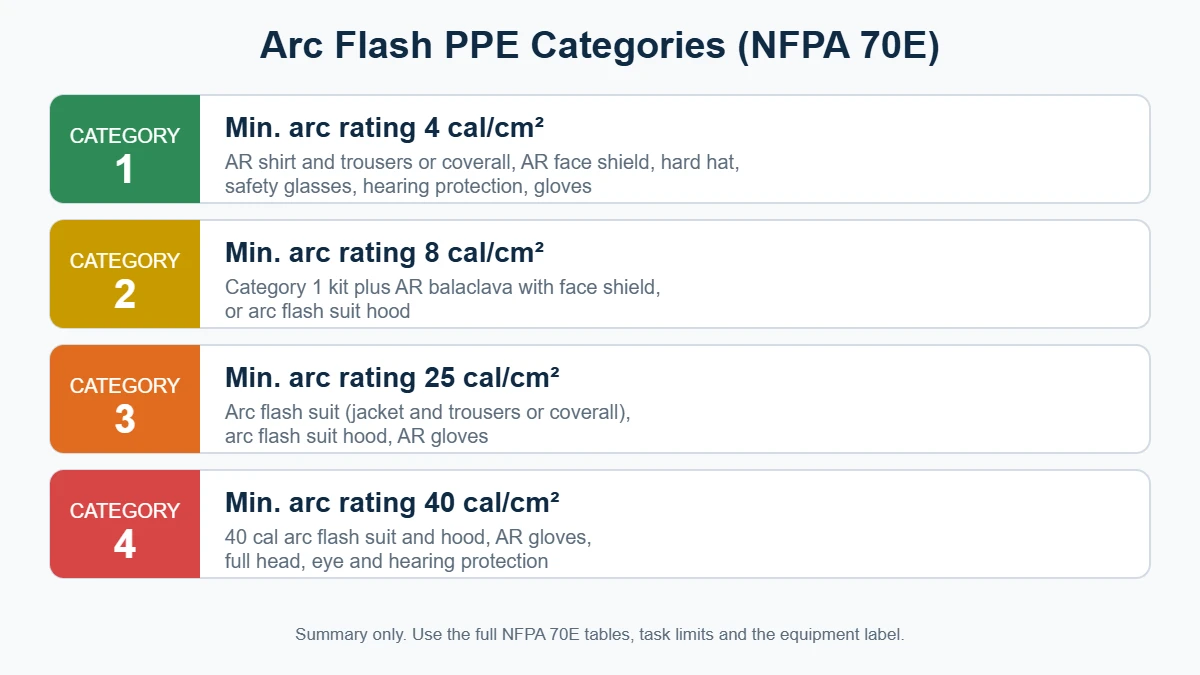
This arc flash PPE requirements chart summarizes NFPA 70E-2021 Table 130.7(C)(15)(c). Always use the full tables, footnotes and task limits in the edition your site follows, or the values on the equipment label. Note that a PPE category number marked on clothing is not an arc rating.
Arc flash labels and arc flash studies
NFPA 70E arc flash label requirements
NFPA 70E requires switchboards, panelboards, industrial control panels, meter socket enclosures and motor control centers, other than in dwelling units, that are likely to require examination, adjustment, servicing or maintenance while energized to carry a label. The label must show:
- Nominal system voltage
- Arc flash boundary
- At least one of: available incident energy and its working distance, or the arc flash PPE category (not both); the minimum arc rating of clothing; or the site-specific level of PPE
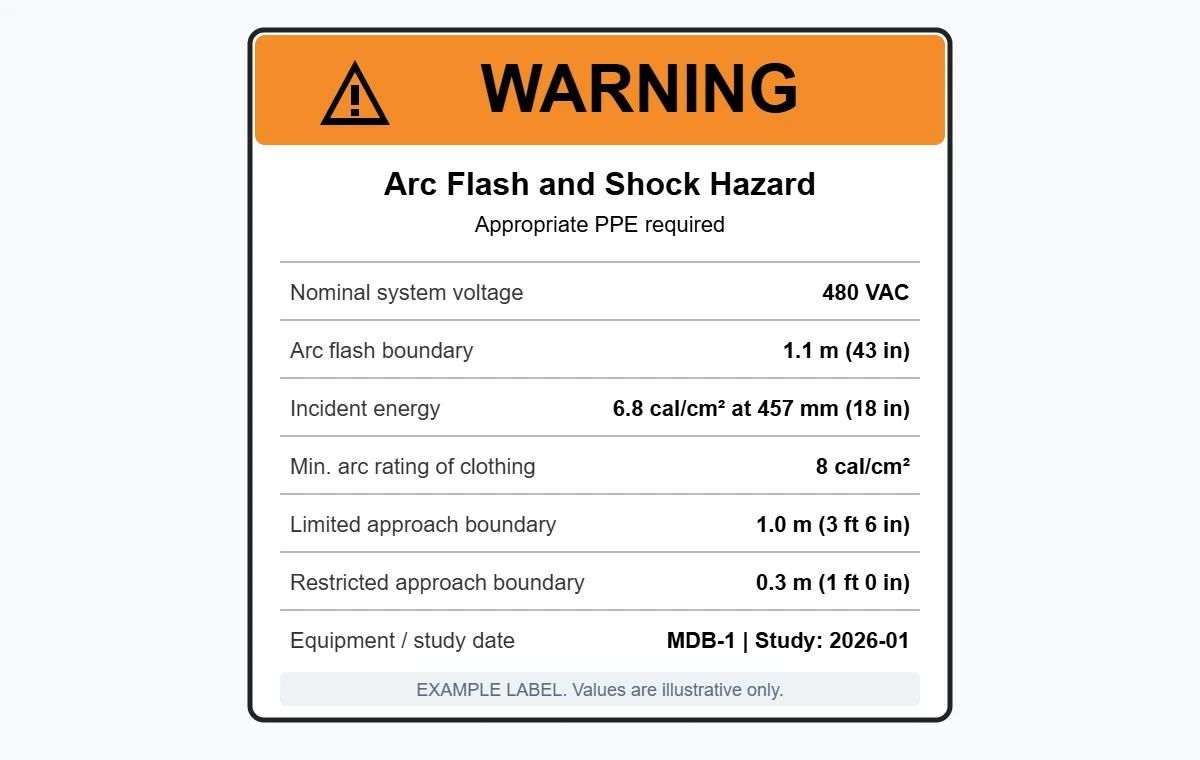
The equipment owner is responsible for documenting, installing and maintaining the label, and the data behind it must be reviewed for accuracy at intervals not exceeding five years. In the US, the National Electrical Code (NEC 110.16) also requires field-marked arc flash warning labels on this kind of equipment. How to read arc flash labels: start with the arc flash boundary (how close you can come without arc-rated PPE), then the incident energy or PPE category (what to wear), then the shock boundaries (how close you can come to exposed parts).
What is an arc flash study?
An arc flash study (also called an arc flash analysis or arc flash hazard analysis) is the engineering assessment that calculates incident energy and arc flash boundaries across a facility. A typical study includes:
- Data collection: single-line diagram, utility fault data, transformers, cables, protective devices and settings.
- Short-circuit study: available fault current at every bus.
- Protective device coordination study: clearing times and settings review.
- Incident energy calculations: typically to IEEE 1584.
- Recommendations: setting changes and mitigation options to reduce incident energy.
- Labels and documentation: printed labels and a report for the electrical safety program.
When is an arc flash study required? Whenever energized work could expose people to an arc flash hazard and the incident energy analysis method is used, or the equipment falls outside the limits of the PPE category tables. Under NFPA 70E, the analysis must be updated when system changes could affect the results, and reviewed for accuracy at intervals not exceeding five years. The same fault levels and device ratings also drive equipment selection. Our breaker size calculator and transformer sizing calculator are useful starting points.
How to prevent arc flash: the hierarchy of risk controls
Effective arc flash protection starts long before anyone puts on PPE. NFPA 70E (110.5(H)(3) in the 2021 edition) requires every risk assessment to apply the hierarchy of risk controls, in this order. The most effective measures come first, and PPE is the last resort.
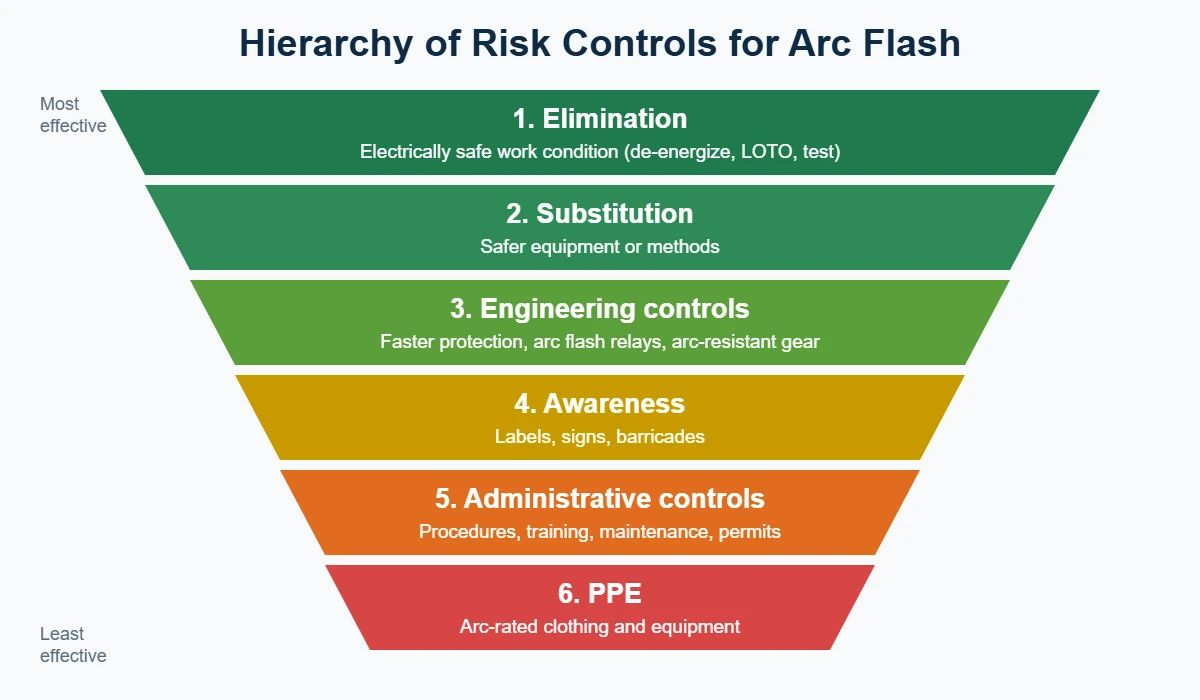
1. Elimination: create an electrically safe work condition
The most reliable protection is to remove the hazard: at the design stage where possible, or by putting the equipment into an electrically safe work condition (disconnect, lockout/tagout, test for absence of voltage) before work starts. NFPA 70E permits energized work only where the employer can show that de-energizing introduces additional hazards or increased risk (for example, shutting down life-support equipment), or that the task is infeasible de-energized because of equipment design or operational limitations. That work then needs an energized electrical work permit.
2. Substitution
Replace equipment with something that reduces the hazard. The NFPA 70E Handbook gives two examples: current-limiting fuses in place of non-current-limiting fuses, and 24 V control circuits in place of 120 V. Arc-resistant switchgear can count as substitution or as an engineering control, depending on when it is chosen.
3. Engineering controls: design arc flash out
This is where electrical design makes the biggest difference. The most effective time to reduce incident energy is at the design stage:
- Faster clearing: instantaneous trip settings and careful protective device coordination.
- Arc energy reduction for large breakers: the NEC (240.87) requires a method such as zone-selective interlocking, differential relaying or an energy-reducing maintenance switch where the highest breaker setting is 1,200 A or more.
- Arc flash detection relays: light-and-current sensing that trips upstream devices in milliseconds.
- Arc-resistant switchgear and MCCs: enclosures that redirect arc products away from the operator.
- Remote operation and remote racking: keep people outside the arc flash boundary.
- Infrared windows and online monitoring: allow inspections without opening covers.
- System design choices: transformer sizing and impedance, splitting large buses, and high-resistance grounding to limit ground-fault arcing.
4. Awareness
Arc flash warning labels, signs and barricades at the arc flash boundary.
5. Administrative controls
A written electrical safety program, job briefings, qualified-person training, and equipment maintenance. A poorly maintained breaker can trip late and multiply the incident energy, which makes any label based on it invalid.
6. Personal protective equipment
Arc-rated clothing, face and head protection, gloves and hearing protection, selected from the label or incident energy analysis and worn correctly.
Arc flash standards and regulations
- NFPA 70E, Standard for Electrical Safety in the Workplace: the core US consensus standard and the source of most NFPA 70E arc flash requirements, covering risk assessment, boundaries, PPE selection, labeling, training and the hierarchy of controls.
- OSHA (29 CFR 1910 Subpart S, 1910.269, 1926 Subpart K and V): legally enforceable requirements. OSHA uses NFPA 70E as the recognized method for meeting its general duty to protect workers.
- NFPA 70 (National Electrical Code): installation requirements, including arc flash warning labels and arc energy reduction.
- IEEE 1584, Guide for Performing Arc-Flash Hazard Calculations: the industry-standard calculation method.
- Outside the US: CSA Z462 in Canada. Elsewhere, arc flash risk assessment is commonly carried out under general electrical safety law using IEEE 1584 calculations, with IEC 61482 for arc-rated protective clothing.
Arc flash FAQ
Which of the following is true of an arc flash?
This question appears in many safety training quizzes. The statements that are true: an arc flash can occur at low voltage; it can reach temperatures of about 35,000 °F; most burns come from ignited clothing; severity depends on fault current, clearing time and distance; and it can happen without anyone touching a conductor directly.
Is an arc flash hotter than the sun?
Yes. At up to about 35,000 °F, an arc can be nearly four times hotter than the sun’s surface (about 10,000 °F).
What is an arc flash boundary defined as?
An arc flash boundary is defined as the distance from a potential arc source at which incident energy equals 1.2 cal/cm² (5 J/cm²), the level at which unprotected skin could receive a second-degree burn.
When is arc flash PPE required?
Whenever a person is inside the arc flash boundary of energized equipment where an arc flash is reasonably likely, for example while opening covers, testing, racking or operating equipment in poor condition.
How often are arc flash studies required?
NFPA 70E requires the analysis to be updated whenever system changes could affect the results, and reviewed for accuracy at least every five years.
What is the difference between arc flash and electric shock?
Shock happens when current passes through the body by contact. Arc flash injures by heat, light and blast, often without any contact. Each has its own boundaries and PPE.
Can you survive an arc flash?
Many workers do survive, especially when they are wearing correctly rated arc-rated PPE and are at the expected working distance. NFPA 70E’s intent is that correctly rated PPE limits the injury to a curable second-degree burn. Without protection, high-energy arc flashes are frequently fatal or cause permanent disability.
How do you reduce arc flash incident energy?
Reduce clearing time (faster protective devices, maintenance switches, arc flash relays), reduce available fault current where practical, and increase working distance through remote operation.
Conclusion
An arc flash turns a routine task into an explosion in milliseconds, but it is a predictable hazard. Calculate the incident energy, label the equipment, de-energize whenever possible, design faster protection into the system, and wear correctly rated PPE when energized work is unavoidable. Together these steps make arc flash safety a matter of engineering and planning, not luck. If your facility has no current arc flash study, or your labels are more than five years old, that is the place to start.
Want to go deeper into electrical design? Explore our free electrical calculators or join our electrical design consultancy course.
References
- OSHA 4472: Protecting Employees from Electric-Arc Flash Hazards (2024)
- OSHA 4474: Establishing Boundaries Around Arc Flash Hazards
- OSHA 4475: Being Aware of Arc Flash Hazards
- NFPA 70E: Standard for Electrical Safety in the Workplace
- IEEE 1584-2018: Guide for Performing Arc-Flash Hazard Calculations

is an electrical engineer and NFPA Certified Electrical Safety Compliance Professional (CESCP) with more than 10 years of industry experience. He specializes in electrical design and consultancy, safety audits and inspections, and construction project execution. He has worked on high-rise towers, residential and commercial buildings, offices, schools, restaurants and industrial facilities. He writes about electrical design, code compliance and practical electrical safety.