Prime vs Standby Generator: Ratings, Differences & How to Choose
Prime vs standby generator ratings confuse many buyers, because every diesel generator datasheet lists more than one output. The same genset might be rated, say, 500 kW standby and 450 kW prime. Picking the wrong rating is one of the most expensive mistakes in generator selection. If you choose standby for a job that needs prime, the engine wears out early and may void its warranty. On the other hand, if you choose prime when standby would do, you pay for a bigger machine than you need.
This prime vs standby generator guide explains the difference between prime and standby generators, the ISO 8528-1 rating definitions behind them, how manufacturers such as Caterpillar and Cummins apply them, and how to choose the right rating for your project.
Key takeaways
- Standby rating: for backup only, while the utility is down. Limited hours per year, around a 70% average load, and no overload.
- Prime rating: for sites where the generator is the main power source. Unlimited hours at a varying load averaging about 70%, usually with a 10% overload for 1 hour in 12.
- Continuous rating: a constant load, up to 100% of the rating, for unlimited hours.
- The same engine and alternator usually carry a higher standby kW and a lower prime kW, because standby duty is lighter.
- Manufacturer definitions differ from ISO and from each other, so always read the rating notes on the datasheet.
What is a prime power generator (prime vs standby)?
A prime rated generator supplies power when there is no utility supply, or when the utility is unreliable. Typical examples are remote mines, oil and gas sites, construction camps, islands and rental fleets. It can run for an unlimited number of hours per year, but the load must vary.
Under ISO 8528-1, the prime power (PRP) rating is the maximum power the set can deliver continuously to a variable load, for unlimited hours. The average output over 24 hours must not exceed 70% of the PRP rating. The set can reach 100% of its nameplate for periods, as long as the average stays within that limit.
Most manufacturers also give prime ratings a 10% overload capability. Caterpillar, for example, allows 10% overload for emergencies for a maximum of 1 hour in 12, and no more than 25 hours per year. This overload capability comes from the engine standard ISO 3046, and it is why factory tests of prime-rated sets include a short run at 110% load.
What is a standby power generator?
A standby rated generator backs up a reliable utility supply. It runs only during an outage and for testing. This is the rating used for most commercial buildings, hospitals, data centers and life safety systems.
ISO 8528-1 calls this emergency standby power (ESP). It is the maximum power the set can deliver during a utility outage or under test, for no more than 200 hours per year, with an average load factor of 70% over 24 hours. There is no overload capability, so the standby kW on the nameplate is the absolute maximum.
Because the standby rating is the top of the machine’s capability, a standby generator should not run in parallel with the utility for peak shaving or base load. Caterpillar, for example, states that its standby rating is not for use in utility paralleling applications.
Prime vs standby generator: side-by-side comparison
Standby vs prime power at a glance:
| Feature | Standby rating | Prime rating |
|---|---|---|
| Purpose | Backup when the utility fails | Main power source where there is no reliable utility |
| Annual running hours | Limited (ISO ESP: up to 200 h/yr; some manufacturer ratings up to 500 h/yr) | Unlimited |
| Average load factor | About 70% over 24 hours (higher for some special ratings) | 70% over 24 hours (ISO PRP) |
| Overload | None | Usually 10% for 1 hour in 12 |
| kW on the same genset | Higher | Lower |
| Utility paralleling | Not intended | Possible within the manufacturer’s rules |
| Typical applications | Hospitals, offices, data centers, fire pumps, life safety | Remote sites, mines, rental power, islands, unreliable grids |
| Maintenance | Based on test runs and outages | Frequent, based on running hours |
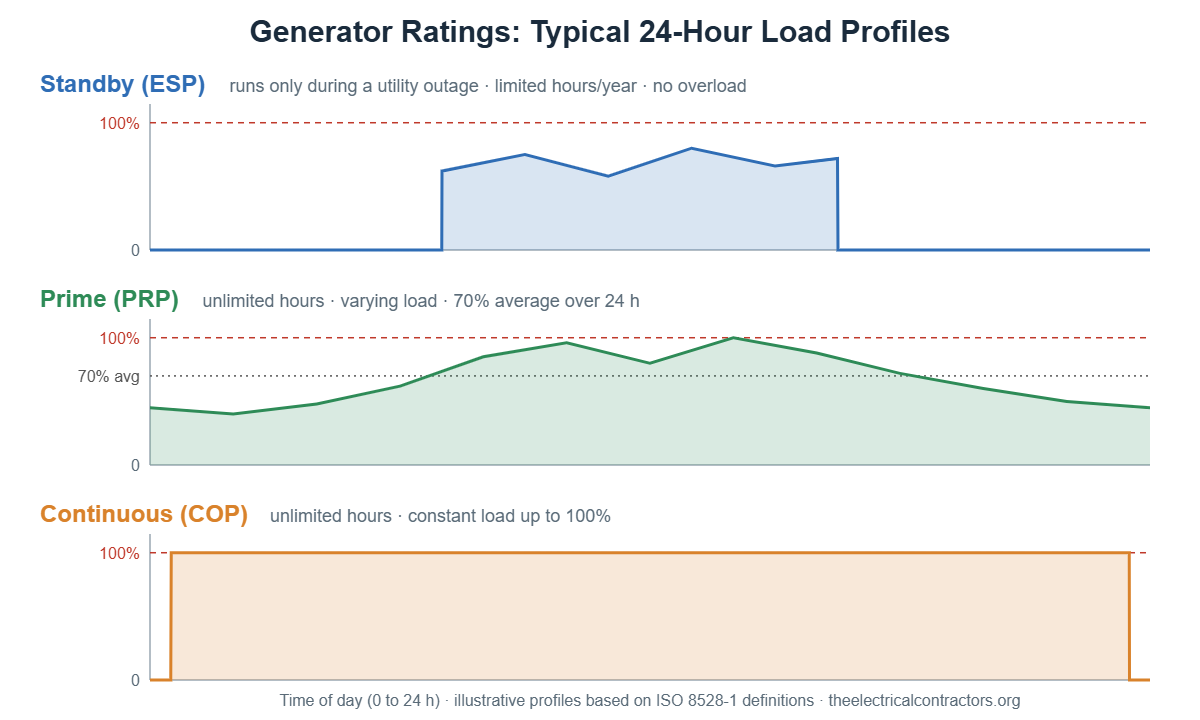
ISO 8528-1 generator ratings explained: standby, prime and continuous power
ISO 8528-1 is the international standard that defines generator set ratings. Its current edition, ISO 8528-1:2018, lists five ratings:
| ISO rating | Load | Hours per year | Typical use |
|---|---|---|---|
| Emergency standby power (ESP) | Variable, 70% average over 24 h | Up to 200 | Backup during utility outages |
| Prime power (PRP) | Variable, 70% average over 24 h | Unlimited | Main power where there is no utility |
| Limited-time running power (LTP) | Constant, up to 100% | Up to 500 | Peak shaving, utility curtailment |
| Continuous operating power (COP) | Constant, up to 100% | Unlimited | Base load, combined heat and power, utility paralleling |
| Data center power (DCP) | Variable or constant | Unlimited, with a reliable utility | Data centers |
Think of these as minimum definitions. Many manufacturers publish their own ratings on top of them. Caterpillar, for example, uses ESP, Standby, Mission Critical, Prime, Prime-DCP and Continuous; some of these have no ISO equivalent. Cummins offers a Data Center Continuous (DCC) rating for unlimited hours with no restriction on the average load. Compare manufacturers by their full definitions, not just the word “standby” or “prime”.
Prime vs standby generator kW: why the same set has two ratings
In the prime vs standby generator comparison, the key is duty. A standby generator runs a few hundred hours a year at most, mostly at part load. As a result, the engine and alternator can run hotter and harder for those short periods without shortening their life. Prime duty runs all year, so the manufacturer derates the same machine to protect it.
- Engine: on modern electronic engines, the software in the engine controller largely decides whether the engine runs to a continuous, prime or standby rating.
- Alternator: NEMA allows standby-rated alternators a temperature rise 25 °C above the continuous-duty limit. That is why the alternator’s standby kVA is higher than its continuous kVA.
On a typical datasheet the prime rating is often around 10% lower than the standby rating. The exact gap depends on the model, so always read the actual figures.
Prime vs standby generator: how to choose
Answer these questions in order:
- Is there a reliable utility supply? If yes, the generator is backup, so start with a standby rating. If no, or if outages are long and frequent, you need prime.
- How many hours will it run each year? If the estimate (testing plus expected outages) could exceed the rating’s annual limit, move up to prime or continuous.
- Is the load constant or variable? A constant load near 100% for long periods needs a continuous (COP) or limited-time (LTP) rating, not standby or prime.
- Will it run in parallel with the utility? Peak shaving, demand response and base load operation need prime or continuous ratings that allow paralleling.
- Does the project have special requirements? Data centers targeting Uptime Institute Tier III or Tier IV, for example, need a rating with no limit on run hours at the required load. Cummins notes that among the ISO definitions only continuous meets this at 100% of the rating, which is why manufacturers created data-center-specific ratings.
Worked example
A remote construction camp has a peak demand of 400 kW, but its average load over a day is about 260 kW. There is no utility, so the generator runs every day.
- Rating needed: prime, because the hours are unlimited.
- Check the peak: 400 kW must not exceed the prime kW, so choose a set with at least 400 kW prime.
- Check the average: 260 ÷ 400 = 65%, within the 70% average limit.
- Result: a genset rated 400 kW or more prime. Its standby rating will be higher, but that figure does not matter for this job.
In contrast, take an office building with the same 400 kW peak, a reliable utility and perhaps 20 hours a year of outages plus monthly testing. A set rated 400 kW or more standby is enough, and it will be a smaller, cheaper machine. To size the load itself, use our generator sizing calculator and the electrical load calculation guide.
“Standby” in the NEC is not the same as a standby rating
Do not confuse the generator’s rating with the code’s system type. The NEC classifies backup systems by what they serve:
- Article 700, emergency systems: life safety loads such as egress lighting and fire alarm.
- Article 701, legally required standby systems: loads required by code, such as smoke control and sewage pumping.
- Article 702, optional standby systems: business continuity and comfort loads.
All three normally use generators with a standby rating, because a reliable utility exists. NFPA 110 then sets how the system is installed and tested. See our guide to generator testing for the monthly and annual requirements.
Common mistakes when choosing a generator rating
- Comparing quotes on different ratings: one supplier quotes 500 kW standby and another quotes 500 kW prime. The prime machine is the larger one.
- Using a standby set as the main power source: it will exceed its annual hours, wear out early and may lose its warranty cover.
- Ignoring the 70% average: a prime set run near 100% all day breaks the rating, even though the nameplate allows short peaks.
- Forgetting site derating: high altitude and high ambient temperature reduce the available kW for every rating type.
- Oversizing “to be safe”: a diesel that runs lightly loaded suffers from wet stacking. Size to the real load.
Frequently asked questions
What is the difference between prime and standby power?
Standby power is the maximum output available during a utility outage, for limited hours per year and with no overload. Prime power is the output available for unlimited hours at a varying load, normally with a 10% overload for short periods.
Is prime power higher than standby power?
No. On the same generator, the prime kW is lower than the standby kW, often by around 10%, because prime duty runs far more hours.
Can a standby generator be used as prime power?
Not at its standby rating. If a generator must run as the main power source, select it at its prime rating, which means a lower usable kW, or choose a larger set.
How many hours can a standby generator run?
Under ISO 8528-1 emergency standby power (ESP), up to 200 hours per year. Some manufacturers publish standby ratings that allow up to 500 hours, so check the datasheet.
What is a continuous power rating?
Continuous operating power (COP) is the output a generator can deliver to a constant load for unlimited hours. It is used for base load, combined heat and power, and utility paralleling.
Which rating should a data center generator have?
Data centers usually need a rating with no limit on run hours, such as ISO data center power (DCP), Cummins DCC or Caterpillar Prime-DCP, especially to meet Uptime Institute Tier III and IV requirements.
Can a prime rated generator be overloaded?
Usually by 10% for 1 hour in every 12 hours of operation, and only for emergencies, with an annual limit. Check the manufacturer’s rating notes. Standby ratings have no overload.
Conclusion
In the prime vs standby generator decision, pick standby when a reliable utility exists and the generator is backup only. Go for prime when the generator is the main power source with a varying load. Finally, use continuous when it must carry a constant load indefinitely. Then read the manufacturer’s rating definitions carefully, because “standby” and “prime” do not mean exactly the same thing on every datasheet.
Next steps: estimate your load with the generator sizing calculator, convert units with the kVA calculator, and learn the basics in generator basics and major components.
References
- Caterpillar: Understanding Generator Set Ratings
- Caterpillar: A Holistic View on Generator Set Ratings
- Cummins PowerHour: Understanding ISO 8528 Generator Set Ratings (PDF)
- ISO 8528-1:2018: Generating sets, application, ratings and performance

is an electrical engineer and NFPA Certified Electrical Safety Compliance Professional (CESCP) with more than 10 years of industry experience. He specializes in electrical design and consultancy, safety audits and inspections, and construction project execution. He has worked on high-rise towers, residential and commercial buildings, offices, schools, restaurants and industrial facilities. He writes about electrical design, code compliance and practical electrical safety.