Generator Testing: Step-by-Step Procedure, Load Bank Tests & NFPA 110 Requirements
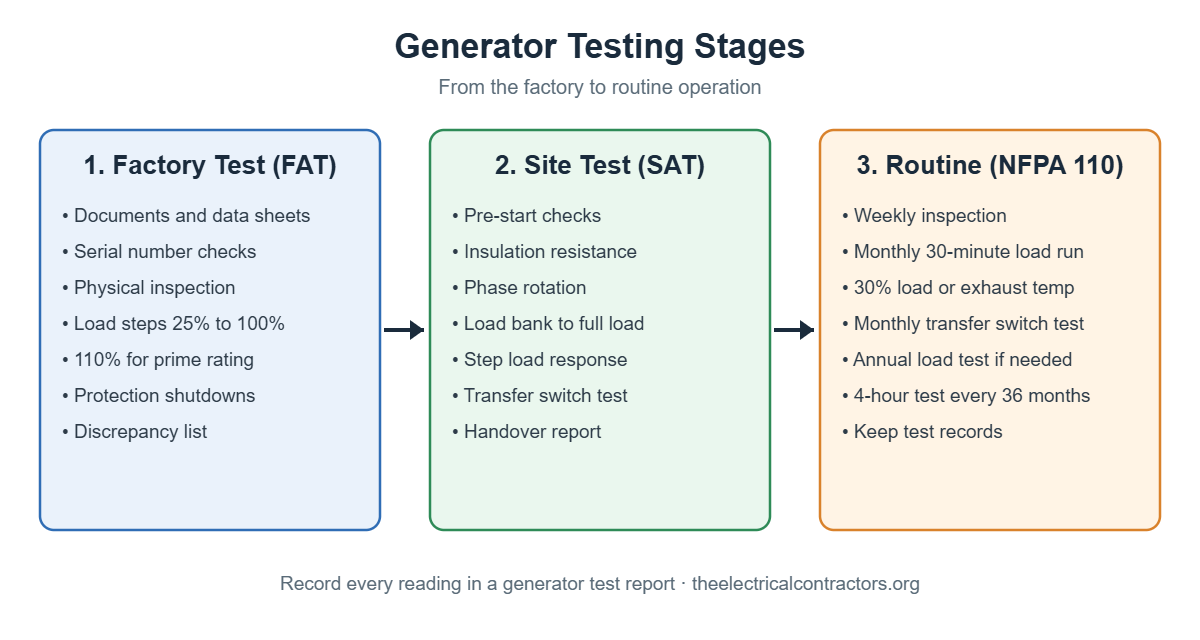
Generator testing is how you prove that a generator set will start, carry its rated load and shut down safely before you need it in an emergency. It runs from the factory acceptance test before shipment, through site commissioning, to the monthly and annual tests that NFPA 110 requires for emergency generators. This guide covers each stage: the step-by-step generator testing procedure, load bank testing, electrical tests, the parameters to record and a test report template you can use.
I wrote the first version of this article after witnessing a factory test of a new diesel genset as the client’s engineer. The photos below are from that inspection. This updated edition adds U.S. code requirements and the site and routine testing that follow, so it works whether you are a consultant, contractor, facility manager or technician.
Key takeaways
- Generator testing happens in three stages: the factory acceptance test (FAT), the site acceptance test and commissioning, and routine periodic testing.
- A complete genset testing procedure covers documents, physical inspection, load testing in steps, electrical tests and every safety shutdown.
- In the U.S., NFPA 110 sets the maintenance and testing rules for emergency and standby power systems. ISO 8528-6 defines internationally recognized test methods.
- Diesel emergency generators must run at least monthly for 30 minutes, either at 30% or more of nameplate kW or at the manufacturer’s minimum exhaust temperature.
- Always record readings in a generator test report and log every deficiency on a discrepancy list.
What is generator testing?
Generator testing is a set of inspections and operating tests that checks a generator set (engine, alternator, controls and protection) against its specification and the applicable codes. Whatever the method, the testing of generators answers three questions:
- Is it the right machine? Do the model, serial numbers and ratings match the approved submittal?
- Does it perform? Does it hold voltage and frequency from no load to full load and recover quickly from sudden load changes?
- Is it safe? Does every protective shutdown and alarm work as designed?
A generator that has never been tested under load is a risk. Problems such as a weak governor, a faulty AVR, wet stacking in a lightly loaded diesel or a failed shutdown switch usually stay hidden until the day of a real outage.
Types of generator testing and generator testing methods
| Test | Where and when | Purpose |
|---|---|---|
| Factory acceptance test (FAT) | Manufacturer’s or distributor’s test bay, before dispatch | Verify the genset meets the specification, witnessed by the client or consultant |
| Site acceptance test (SAT) and commissioning | On site, after installation | Prove the installed system works with the building: load bank, transfer switch, protection, controls |
| Load bank testing | FAT, SAT and annually as needed | Apply controlled artificial load up to full rating |
| Electrical testing | FAT, SAT and maintenance | Insulation resistance, phase rotation, voltage and frequency regulation, transient response |
| Routine (periodic) testing | Weekly, monthly, annually, every three years | Keep the system ready and meet NFPA 110 and the Authority Having Jurisdiction (AHJ) |
Generator testing standards and requirements
Which generator testing standards apply depends on the project, but these are the main references:
- NFPA 110, Standard for Emergency and Standby Power Systems. It covers installation acceptance testing and routine maintenance and operational testing in the United States.
- NFPA 70 (NEC), Articles 700, 701 and 702. These cover emergency, legally required standby and optional standby systems, including witness testing of emergency systems.
- ISO 8528-6, the test methods for engine-driven AC generating sets. The current third edition was published in 2023 and covers functional, type and acceptance tests. ISO 8528-5 sets the performance limits.
- NETA ATS, the acceptance testing specification used by many independent electrical testing firms.
- The project specification and the manufacturer’s test protocol. These usually decide the exact load steps, durations and acceptance values.
Healthcare facilities also follow NFPA 99 and Joint Commission requirements, and the local AHJ can add its own.
Factory acceptance test: step-by-step generator testing procedure
The factory acceptance test usually takes place at the manufacturer’s facility or an authorized distributor’s warehouse. Representatives of all stakeholders, such as the client, consultant and contractor, witness load tests and functional and protection tests before the genset is dispatched to site. If you are the engineer witnessing this test, the generator test procedure below shows what to prepare and check.
Step 1: Collect the test protocol and data sheets
Before the test date, ask the manufacturer or supplier for the complete genset test protocol and the data sheets of the generator to be tested. Check that the protocol records at least the following:
| Genset | Engine | Alternator | Control panel |
|---|---|---|---|
| Model number | Model number | Model number | Voltmeter |
| Serial number | Serial number | Serial number | Ammeter |
| kVA rating (prime and standby) | Make and country of origin | Make and country of origin | Frequency |
| Make and country of origin | Governor type (electronic) | Nominal kVA capacity | Power factor |
| Year of manufacture (prefer latest) | Water-cooled or air-cooled | AVR model | Oil pressure, coolant temperature, battery voltage, emergency stop |

Step 2: Physical inspection and verification
At the test facility you will receive a file with the details above. Then verify the generator physically against the documents:
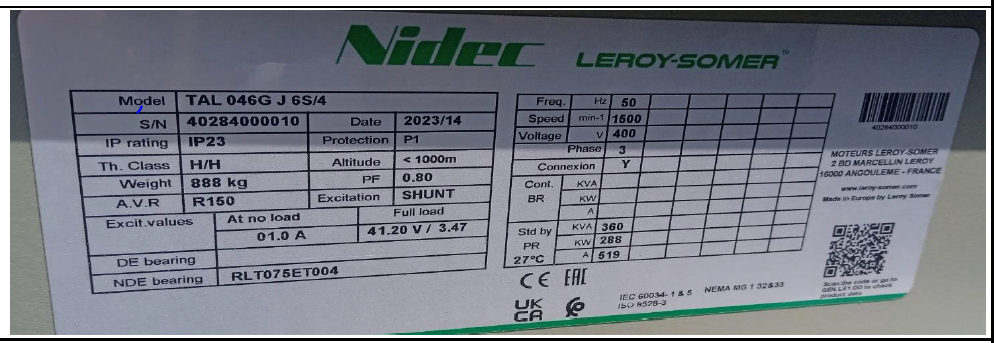
- Genset serial number: check it on the manufacturer’s nameplate.
- Engine serial number: compare it with the documents, then verify it through the engine maker’s app or online portal if one exists. Perkins, for example, has an app for this.
- Alternator serial number: compare the nameplate with the documents.
- General condition: look for physical damage, dents, scratches, corrosion or signs of mishandling on the frame, enclosure and external components.
- Jacket water heater: confirm it is fitted and working. It preheats the coolant so the engine starts easily and takes load quickly, which matters most in cold climates and for emergency generators.
- Running hours: read them on the controller, or ask the supplier’s representative. A new generator should show no more than a few hours.


Step 3: Load testing in steps
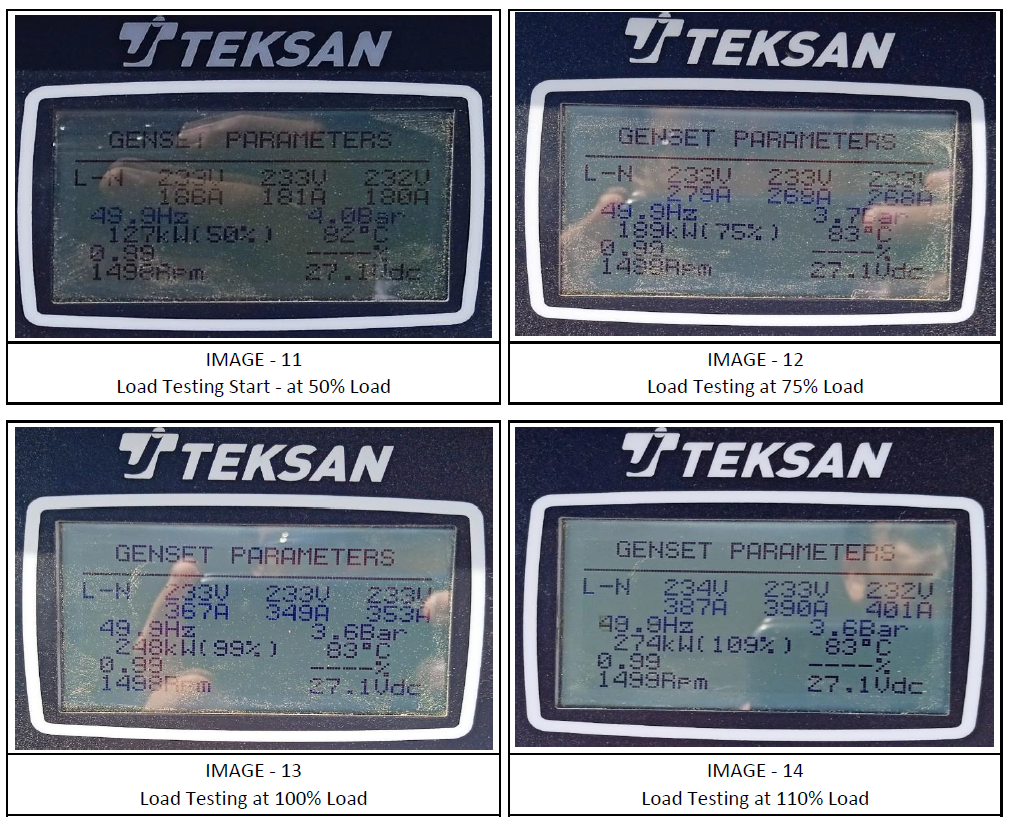
During load testing, the generator runs at increasing loads, from low load to full load and, for prime-rated sets, a short overload. The aim is to check its behavior and its ability to take load. Listen as well as read the meters: any abnormal noise, vibration, smoke or hunting at a particular load points to a problem that needs investigation.
- Start the generator and let it reach operating temperature.
- Apply about 25% load and hold it for an agreed period. The protocol or specification sets the timing.
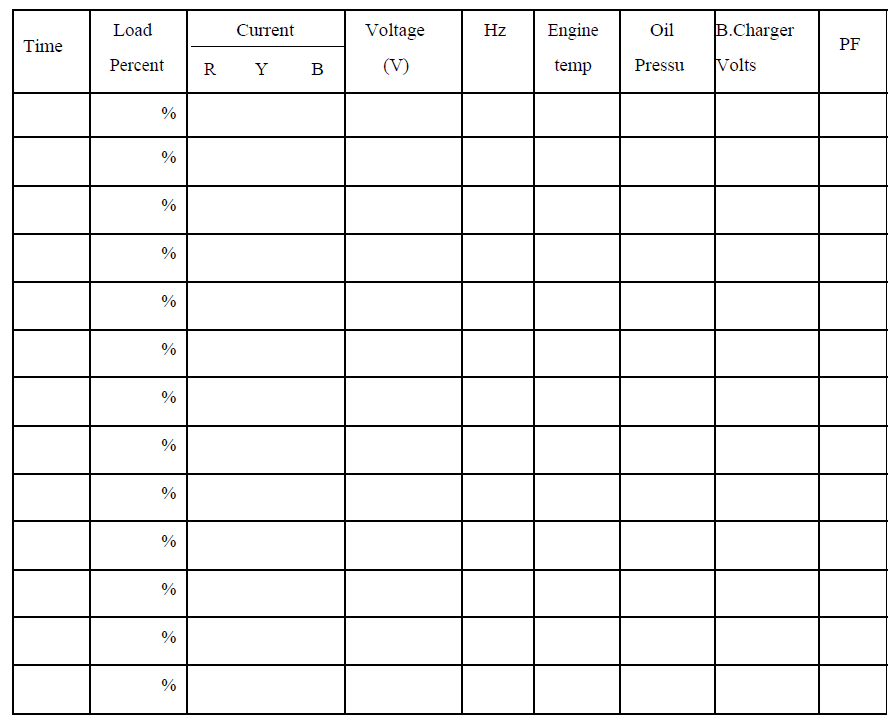
- Increase to 50%, 75% and 100% load, holding each step. At every step, record voltage, current, frequency, power factor, kW, oil pressure and coolant temperature.
- For a prime-rated generator, run at 110% load for a short period, typically 10 to 15 minutes in a factory test. This is because prime ratings normally include a 10% overload for limited periods, typically 1 hour in every 12 hours of operation. Standby ratings do not include an overload.
- Finally, reduce the load, let the engine cool down and stop it.
Step 4: Safety function and protection tests
Generator safety function tests confirm that the protection will shut the set down or raise an alarm before damage occurs. Witness each one:
- Fail-to-start (overcrank) test
- High coolant temperature shutdown
- Low oil pressure shutdown
- Overspeed and underspeed shutdown
- Over-frequency and under-frequency shutdown
- Over-voltage and under-voltage alarm or trip
- Emergency stop shutdown
- Overcurrent and short-circuit protection
- Low fuel level and battery charger fail alarms
Step 5: Record discrepancies and sign the report
After the functional tests, complete the document provided by the supplier. Write every deficiency or abnormal observation on a discrepancy list and ask the supplier to clarify or correct each item before dispatch. Testing a generator is a serious responsibility because it protects a large investment for the client. So prepare well, understand the machine before you arrive, and be proactive during the inspection.
Generator load testing procedure and load bank testing
A building rarely provides a controlled full load on demand, so generator load testing normally uses a load bank. A load bank is a portable or permanently installed device that applies an artificial electrical load in steps.
- Resistive load banks apply kW at unity power factor. They are the most common choice and test the engine and cooling system.
- Resistive/reactive load banks add inductive kVAR, typically for testing at 0.8 power factor. They also test the alternator, voltage regulation, load sharing and transient response, which a resistive-only test cannot fully do.
Manufacturers often test production gensets at full load and rated power factor in the factory. Where that factory test has been done, NFPA 110 permits the on-site acceptance test at unity power factor.
A typical site load bank test increases the load at set intervals, for example 30% for 30 minutes, 50% for 30 minutes and 100% for 60 minutes, while you record readings every 15 minutes. The project specification sets the exact steps.
Generator electrical testing
Besides running under load, a complete set of generator tests includes these electrical checks:
| Test | What it checks | How |
|---|---|---|
| Insulation resistance (megger) | Condition of the stator and rotor winding insulation | Insulation tester at the voltage the manufacturer specifies; compare with the manufacturer’s minimum and IEEE 43 guidance |
| Winding resistance | Balance between phases, loose connections | Low-resistance ohmmeter on each winding |
| Phase rotation | Correct sequence before connecting to the building | Phase rotation meter at the generator breaker |
| Voltage and frequency regulation | Steady-state stability from no load to full load | Record at each load step |
| Step load (transient) response | Voltage dip, frequency dip and recovery time when load is applied or rejected | Apply and reject block loads; compare with the specified ISO 8528-5 performance class |
| Transfer switch test | Start signal, transfer and retransfer, time delays | Simulate a utility failure and time the transfer |
| Synchronizing and load sharing | Paralleled sets share kW and kVAR correctly | Load the bus and compare each set’s output |
For life safety emergency systems, the generator must pick up the emergency load within 10 seconds of a utility failure. That is an NFPA 110 Type 10 system, so time the transfer during commissioning.
Generator testing and commissioning procedure on site
After installation, the site acceptance test proves that the complete system works, not just the generator. A practical generator testing and commissioning procedure looks like this:
- Pre-start checks: mounting, anti-vibration pads, exhaust and fuel connections, coolant and oil levels, battery and charger, ventilation and cable terminations.
- Cable and earthing checks: insulation resistance of feeders, tightness of terminations, and the generator neutral and bonding arrangement as designed. See our guide to earthing and grounding.
- First start and no-load run: check voltage, frequency, phase rotation, oil pressure and any leaks.
- Load bank test to full rated load, as described above.
- Building load test: simulate a utility failure by opening the normal supply and confirm that the transfer switch transfers, the loads restart in the right sequence, and the system retransfers when utility power returns.
- Protection and alarms: repeat the key shutdown tests and confirm the remote alarms and monitoring.
- Handover: test report, as-built drawings, settings, O&M manuals and operator training.
NFPA 110 generator testing requirements
Once a system is in service, NFPA 110 Chapter 8 sets the routine generator testing requirements. The summary below is for emergency power supply systems (EPSS). Always check the edition your AHJ has adopted.
| Frequency | Requirement (summary) |
|---|---|
| Weekly | Inspect the EPSS: fuel, coolant, oil, batteries, charger, and alarms |
| Monthly | Run at least 30 minutes under load, at not less than 30% of standby nameplate kW or at the manufacturer’s minimum exhaust gas temperature |
| Annually (diesel units that fail the monthly load) | Supplemental load test: 50% of nameplate for 30 minutes, then 75% for 60 minutes (1.5 hours continuous) |
| Every 36 months (Level 1) | Run for at least 4 hours at not less than 30% of nameplate kW |
| Monthly | Operate each automatic transfer switch |
The 30% rule exists because diesel engines that run lightly loaded suffer from wet stacking. Unburned fuel and soot build up in the exhaust and engine. Recent editions clarify that spark-ignited (gas) generators do not need the 30% load, because they are not subject to wet stacking.
Generator testing parameters and test report template
A useful generator test report records the same parameters at every load step, so you can compare results over time. Here is a simple template:
| Load step | Time | kW | Voltage L-L (V) | Current per phase (A) | Frequency (Hz) | Power factor | Oil pressure | Coolant temp | Remarks |
|---|---|---|---|---|---|---|---|---|---|
| No load | |||||||||
| 25% | |||||||||
| 50% | |||||||||
| 75% | |||||||||
| 100% | |||||||||
| 110% (prime only) |
Also record the genset, engine and alternator serial numbers, the ambient temperature, the fuel level, the running hours before and after, the results of each protection test, and the names and signatures of the witnesses. Use our kVA calculator to convert between kW, kVA and amps when you check the readings.
Common problems found during generator testing
- Serial numbers or ratings that do not match the approved submittal: stop and clarify before testing.
- Voltage or frequency hunting under load: usually a governor or AVR setting issue.
- Excessive voltage dip on block loads: undersized alternator or slow excitation. Check the generator sizing against motor starting loads.
- Black smoke and wet stacking: typical of diesels that run lightly loaded for long periods.
- High coolant temperature at full load: blocked radiator or poor ventilation.
- A protection device that does not trip: a failed sensor or a bypassed shutdown. Never accept the set until it is fixed and retested.
Safety during generator testing
Load bank testing involves live conductors at full generator output, hot exhaust and moving parts. Only qualified persons should make connections, under an energized work permit or with the equipment de-energized and locked out. Wear the PPE the incident energy analysis requires; see our guide to arc flash. Keep the load bank exhaust clear of people and combustibles, and confirm hearing protection near running engines.
Frequently asked questions
What is generator testing?
Generator testing is a set of inspections and operating tests that verifies a generator set starts, carries its rated load, holds voltage and frequency, and shuts down safely on every protective function.
How often should a generator be tested?
For emergency systems under NFPA 110, inspect weekly and run under load at least monthly for 30 minutes. Diesel sets that cannot reach 30% load need an annual supplemental load test, and Level 1 systems need a 4-hour test every 36 months.
What is a generator load bank test?
A load bank test connects an artificial load to the generator and increases it in steps up to full rating, so you can verify performance without using the building’s loads.
What is the difference between FAT and SAT?
The factory acceptance test (FAT) verifies the genset at the manufacturer’s facility before shipment. The site acceptance test (SAT) verifies the installed system on site, including the transfer switch, building loads and protection.
What parameters are recorded during generator testing?
Kilowatts, voltage, current per phase, frequency, power factor, oil pressure, coolant temperature, running hours and the results of each safety shutdown test.
Can a generator be tested without load?
A no-load run checks starting and basic operation, but it does not prove that the generator can carry its rated load. Diesel engines should not run at light load for long because of wet stacking.
Which standard covers generator testing?
In the United States, NFPA 110 covers emergency and standby power system testing, with the NEC (Articles 700 to 702). Internationally, ISO 8528-6 defines test methods for engine-driven generating sets.
Conclusion
Good generator testing follows the machine through its whole life. Witness the factory test carefully, commission the installed system with a full load bank and transfer test, and then keep up the routine NFPA 110 testing. Record every reading in a consistent test report so you can spot problems early.
Planning a new installation? Start with our generator sizing calculator, read about generator basics and major components, or see how generators appear on a single-line diagram.
References
- NFPA 110: Standard for Emergency and Standby Power Systems
- ISO 8528-6:2023: Generating sets, test methods
- The Joint Commission: Emergency generator load test FAQ
- Consulting-Specifying Engineer: Commissioning and testing gensets using resistive/reactive load banks

is an electrical engineer and NFPA Certified Electrical Safety Compliance Professional (CESCP) with more than 10 years of industry experience. He specializes in electrical design and consultancy, safety audits and inspections, and construction project execution. He has worked on high-rise towers, residential and commercial buildings, offices, schools, restaurants and industrial facilities. He writes about electrical design, code compliance and practical electrical safety.