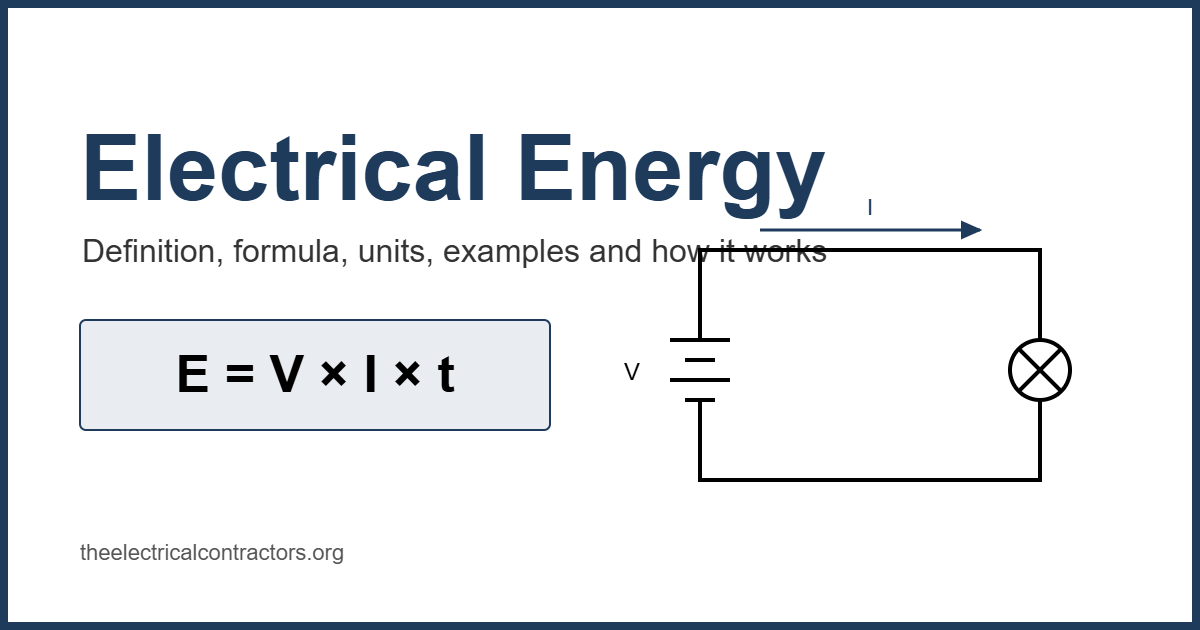
Electrical energy explained: definition, formula E = V x I x t, units and examples

Electrical Energy: Definition, Formula, Units & Examples

Electrical energy is the energy carried by moving electric charges, usually electrons, when they flow through a voltage. You can calculate it with E = V × I × t. Its SI unit is the joule (J), and your electric bill measures it in kilowatt-hours (kWh).

Whether you are checking a homework answer, trying to make sense of your electric bill, or brushing up on the basics as a technician or engineer, this guide covers what you need. You will learn the definition, the formulas, the units and whether it is potential or kinetic energy. You will also find real-life examples, step-by-step solved problems, U.S. energy data and practice questions with answers.

In this guide: Quick reference · Definition · How it works · Formula and solved examples · Potential or kinetic? · Examples · Sources · Storage · Common mistakes · Practice questions · FAQ

Quick reference

TopicWhat to remember
DefinitionEnergy transferred by moving electric charge through a potential difference
Main formulaE = V × I × t, also written E = P × t
SI unitJoule (J). 1 J = 1 watt for 1 second
Everyday unitKilowatt-hour (kWh). 1 kWh = 3,600,000 J
Potential or kinetic?Common answer: kinetic when charges flow, potential when stored
Type of sourceSecondary: we make electricity from primary sources such as gas, coal, nuclear, wind and sunlight
Energy vs powerEnergy is the total amount; power is how fast it is used (watts)

Electrical energy definition: what is electrical energy?

Electrical energy simple definition: it is the energy that electricity carries from a source, such as a battery or power plant, to a device. The device then changes it into light, heat, sound or motion.

Physics definition: it is the energy transferred when a charge Q moves through a potential difference V. In other words, E = Q × V. So when 1 coulomb of charge passes through 1 volt, it transfers 1 joule.

If you need to define electrical energy in one line, use that second version. It is the definition of electrical energy most textbooks and engineering references use. You may also see the term electric energy; it means the same thing.

So what does electrical energy mean in daily life? Think of it as a delivery service for energy. A power plant hundreds of miles away can send energy to your phone charger almost instantly. Once it arrives, your devices can turn it into almost any other form. That flexibility is why the electrical energy meaning matters so much in the modern world.

Key terms you need to know

QuantitySymbolSI unitMeaning
ChargeQcoulomb (C)Amount of electricity
Voltage (potential difference)Vvolt (V)Energy given to each coulomb (1 V = 1 J/C)
CurrentIampere (A)Rate of flow of charge (1 A = 1 C/s)
ResistanceRohm (Ω)How much a material opposes current
PowerPwatt (W)Rate of energy transfer (1 W = 1 J/s)
EnergyEjoule (J)Total energy transferred
Timetsecond (s)How long the current flows

How does electrical energy work?

Every circuit needs three things:

  • A source, such as a battery, generator or solar cell. It creates a voltage that pushes charge.
  • A closed path of wires and a switch, so charge can flow as a current.
  • A load, such as a lamp, motor or heater, which changes the energy into another form.

When you close the switch, the voltage pushes charge around the loop. Each coulomb that passes through the load gives up energy equal to the voltage. For example, a 120-volt lamp receives 120 joules from every coulomb that flows through it.
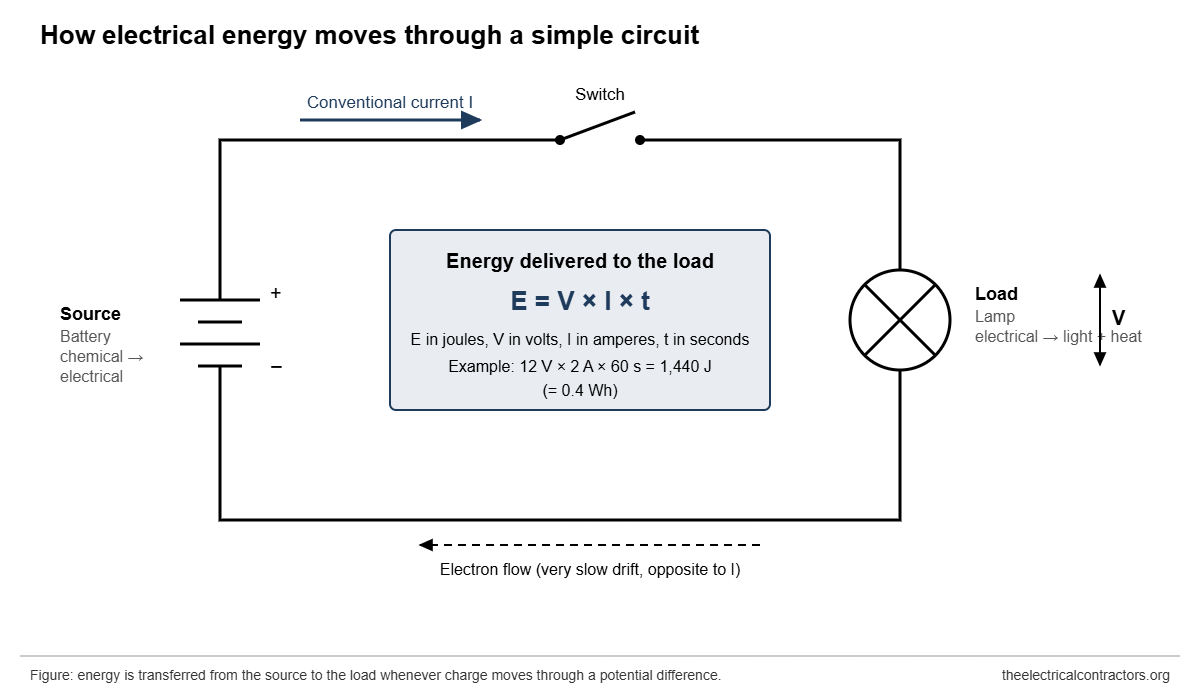
Simple circuit diagram showing how electrical energy moves from a battery to a lamp, with voltage, current and E = V x I x t
A battery, switch and lamp. Energy flows from the source to the load: 12 V × 2 A × 60 s = 1,440 J.

A helpful analogy: picture water in a pipe. Voltage is like the water pressure, current is like the flow rate, and the energy delivered depends on both and on how long the water runs. The analogy is not perfect, but it helps you remember which quantity does what.

Electrical energy vs electrical power

People often mix these up, so it helps to get the difference clear. Power is the rate of energy transfer, measured in watts. Energy is the total amount transferred, measured in joules or kilowatt-hours.

For example, a 100 W bulb always draws 100 W. However, if you leave it on for 10 hours, it uses 100 W × 10 h = 1,000 Wh, which equals 1 kWh. In short, power tells you how fast; energy tells you how much.

Electrical energy formula: how to calculate electrical energy

FormulaUse it when you know
E = Q × VCharge (C) and voltage (V)
E = P × tPower (W) and time (s or h)
E = V × I × tVoltage, current (A) and time
E = I² × R × tCurrent and resistance (Ω)
E = V² × t ÷ RVoltage and resistance
E = ½ × C × V²Energy stored in a capacitor (C in farads)

Where do these come from? Start with E = Q × V. Because Q = I × t, you get E = V × I × t. Then, since P = V × I, this becomes E = P × t. Finally, Ohm’s law (V = I × R) lets you swap V or I to get the I²Rt and V²t/R versions. So you only need to memorize one formula and two links.

Tip: always convert to SI units first. Use seconds, not minutes, and amperes, not milliamperes, if the answer must be in joules.

Solved example 1: energy in joules

Question: A 12 V battery drives a current of 2 A through a lamp for 5 minutes. How much energy does the lamp receive?

  • Given: V = 12 V, I = 2 A, t = 5 min = 300 s
  • Formula: E = V × I × t
  • Solution: E = 12 × 2 × 300 = 7,200 J (7.2 kJ)

Solved example 2: heat in a resistor

Question: A current of 3 A flows through a 10 Ω heater for 1 minute. Find the heat produced.

  • Given: I = 3 A, R = 10 Ω, t = 60 s
  • Formula: E = I² × R × t
  • Solution: E = 3² × 10 × 60 = 9 × 10 × 60 = 5,400 J

Solved example 3: what a space heater costs

Question: A 1,500 W space heater runs 4 hours a day for 30 days. Electricity costs 16.5 cents per kWh, close to the 2024 U.S. residential average. What is the monthly cost?

  • Energy: 1.5 kW × 4 h × 30 = 180 kWh
  • Cost: 180 × 0.165 = <strong>29.70 per month

Solved example 4: switching to an LED bulb

Swap a 60 W incandescent bulb for a 9 W LED and use it 5 hours a day for a year. You save (60 − 9) × 5 × 365 = 93,075 Wh, or about 93 kWh. At 16.5 ¢/kWh, that is roughly 15 per bulb per year</strong>. <!-- /wp:paragraph -->  <!-- wp:heading {"level":3} --> <h3 class="wp-block-heading">Solved example 5: energy in a capacitor</h3> <!-- /wp:heading -->  <!-- wp:paragraph --> A 1,000 µF capacitor charged to 400 V stores E = ½ × 0.001 × 400² = <strong>80 J</strong>. That is enough for a dangerous shock. For this reason, technicians always discharge large capacitors before they work on equipment. <!-- /wp:paragraph -->  <!-- wp:heading {"level":3} --> <h3 class="wp-block-heading">Units: what is electrical energy measured in?</h3> <!-- /wp:heading -->  <!-- wp:image --> <figure class="wp-block-image"><img src="https://www.theelectricalcontractors.org/wp-content/uploads/2026/11/electrical-energy-formulas-units.png" alt="Electrical energy formulas (E = QV, E = Pt, E = VIt, E = I squared R t) and units: joule, watt-hour, kilowatt-hour, electron-volt"/><figcaption class="wp-element-caption">The main formulas and units at a glance.</figcaption></figure> <!-- /wp:image -->  <!-- wp:list --> <ul class="wp-block-list"><!-- wp:list-item --> <li><strong>Joule (J):</strong> the SI unit. 1 J = 1 watt for 1 second.</li> <!-- /wp:list-item -->  <!-- wp:list-item --> <li><strong>Watt-hour (Wh):</strong> 3,600 J. Phone and laptop batteries use it.</li> <!-- /wp:list-item -->  <!-- wp:list-item --> <li><strong>Kilowatt-hour (kWh):</strong> 1,000 Wh = 3.6 MJ. Every U.S. utility bill uses it, and some textbooks call it the "commercial unit" or one "unit" of electricity.</li> <!-- /wp:list-item -->  <!-- wp:list-item --> <li><strong>Electron-volt (eV):</strong> 1.602 × 10⁻¹⁹ J. Physicists use it for single particles.</li> <!-- /wp:list-item --></ul> <!-- /wp:list -->  <!-- wp:paragraph --> <strong>Conversion to remember:</strong> 1 kWh = 1,000 W × 3,600 s = 3.6 × 10⁶ J. <!-- /wp:paragraph -->  <!-- wp:paragraph --> <strong>One watt is equal to what?</strong> A watt is a rate, not an amount: <strong>1 watt = 1 joule per second</strong>. <!-- /wp:paragraph -->  <!-- wp:heading {"anchor":"potential-or-kinetic"} --> <h2 id="potential-or-kinetic" class="wp-block-heading">Is electrical energy potential or kinetic?</h2> <!-- /wp:heading -->  <!-- wp:paragraph --> <strong>Short answer:</strong> it can be both. It is <strong>kinetic</strong> when charges are moving, as in current electricity. It is <strong>potential</strong> when charge is stored, as in a battery, a capacitor or static electricity. This is the answer most textbooks give. <!-- /wp:paragraph -->  <!-- wp:paragraph --> <strong>Deeper answer:</strong> physicists describe the energy a circuit delivers as <strong>electrical potential energy</strong> (also called electric potential energy). A charge q at potential V has energy U = q × V, and it releases that energy as it moves to a lower potential. Surprisingly, electrons in a wire drift very slowly, usually well under a millimeter per second. As a result, their kinetic energy is tiny. Instead, the energy travels through the electromagnetic field around the wires. That is why a lamp lights almost instantly when you flip the switch, even though each electron barely moves. <!-- /wp:paragraph -->  <!-- wp:image --> <figure class="wp-block-image"><img src="https://www.theelectricalcontractors.org/wp-content/uploads/2026/11/electrical-energy-potential-vs-kinetic.png" alt="Diagram comparing electric potential energy stored between capacitor plates with the slow drift of electrons in a wire"/><figcaption class="wp-element-caption">Stored potential energy (U = qV) compared with current in a wire.</figcaption></figure> <!-- /wp:image -->  <!-- wp:heading {"anchor":"examples"} --> <h2 id="examples" class="wp-block-heading">Examples of electrical energy</h2> <!-- /wp:heading -->  <!-- wp:paragraph --> You use this energy all day. Here are common electrical energy examples, grouped by what they turn it into: <!-- /wp:paragraph -->  <!-- wp:list --> <ul class="wp-block-list"><!-- wp:list-item --> <li><strong>Light:</strong> LED bulbs and screens.</li> <!-- /wp:list-item -->  <!-- wp:list-item --> <li><strong>Heat:</strong> toasters, kettles, stoves and space heaters, which use resistance (E = I²Rt).</li> <!-- /wp:list-item -->  <!-- wp:list-item --> <li><strong>Motion:</strong> motors in fans, washing machines, blenders and electric cars.</li> <!-- /wp:list-item -->  <!-- wp:list-item --> <li><strong>Sound:</strong> speakers, headphones and doorbells.</li> <!-- /wp:list-item -->  <!-- wp:list-item --> <li><strong>Chemical energy:</strong> charging a phone or car battery.</li> <!-- /wp:list-item -->  <!-- wp:list-item --> <li><strong>Lightning:</strong> a giant natural discharge of static charge between clouds and the ground.</li> <!-- /wp:list-item -->  <!-- wp:list-item --> <li><strong>Static shock:</strong> the zap from a doorknob after you walk across carpet.</li> <!-- /wp:list-item -->  <!-- wp:list-item --> <li><strong>Your body:</strong> nerves send electrochemical signals, and electric eels can release several hundred volts.</li> <!-- /wp:list-item --></ul> <!-- /wp:list -->  <!-- wp:paragraph --> <strong>Quick calculation:</strong> a 10 W phone charger running for 2 hours uses 10 × 2 = 20 Wh, which equals 72,000 J. <!-- /wp:paragraph -->  <!-- wp:heading {"anchor":"sources"} --> <h2 id="sources" class="wp-block-heading">Where does electrical energy come from?</h2> <!-- /wp:heading -->  <!-- wp:paragraph --> Electricity is a <strong>secondary energy source</strong>. In other words, we make it by converting a primary source such as natural gas, coal, uranium, wind, sunlight or flowing water. <!-- /wp:paragraph -->  <!-- wp:paragraph --> Most power plants rely on <strong>electromagnetic induction</strong>, which Michael Faraday discovered in 1831. When a magnet moves past a coil of wire, it creates a voltage in the coil. Steam, gas, water or wind spins a turbine, and the turbine turns the <a href="/design/generators-basics-major-components/">generator</a>. <!-- /wp:paragraph -->  <!-- wp:paragraph --> How is electrical energy produced in other ways? There are four more methods worth knowing: <!-- /wp:paragraph -->  <!-- wp:list --> <ul class="wp-block-list"><!-- wp:list-item --> <li><strong>Solar cells:</strong> light knocks electrons loose in a semiconductor.</li> <!-- /wp:list-item -->  <!-- wp:list-item --> <li><strong>Batteries and fuel cells:</strong> chemical reactions push charge between two electrodes. See our <a href="/understanding-batteries-a-comprehensive-guide/">guide to batteries</a>.</li> <!-- /wp:list-item -->  <!-- wp:list-item --> <li><strong>Thermoelectric devices:</strong> a temperature difference between two metals creates a voltage (the Seebeck effect).</li> <!-- /wp:list-item -->  <!-- wp:list-item --> <li><strong>Piezoelectric crystals:</strong> squeezing them creates a voltage, as in a gas-grill lighter.</li> <!-- /wp:list-item --></ul> <!-- /wp:list -->  <!-- wp:heading {"level":3} --> <h3 class="wp-block-heading">Sources of electricity in the United States</h3> <!-- /wp:heading -->  <!-- wp:image --> <figure class="wp-block-image"><img src="https://www.theelectricalcontractors.org/wp-content/uploads/2026/11/us-electricity-generation-mix-2025.png" alt="Bar chart of U.S. utility-scale electricity generation by source in 2025: natural gas 41%, renewables 24%, nuclear 18%, coal 17%"/><figcaption class="wp-element-caption">U.S. utility-scale electricity generation by source, 2025 (EIA, preliminary).</figcaption></figure> <!-- /wp:image -->  <!-- wp:paragraph --> According to the U.S. Energy Information Administration (EIA), natural gas produced about 41% of U.S. utility-scale electricity in 2025. Renewables came next at about 24%, led by wind (about 11%) and hydropower (about 6%). Nuclear supplied about 18%, and coal about 17%. <!-- /wp:paragraph -->  <!-- wp:heading {"level":3} --> <h3 class="wp-block-heading">How electricity reaches your home</h3> <!-- /wp:heading -->  <!-- wp:image --> <figure class="wp-block-image"><img src="https://www.theelectricalcontractors.org/wp-content/uploads/2026/11/electrical-energy-power-plant-to-home.png" alt="Diagram of how electrical energy travels from the power plant through transmission and distribution to a home meter"/><figcaption class="wp-element-caption">From the generator to the meter: step-up, transmission, step-down and distribution.</figcaption></figure> <!-- /wp:image -->  <!-- wp:paragraph --> First, <a href="/transformer-sizing-calculator/">transformers</a> at the power plant raise the voltage to hundreds of thousands of volts. Why? A higher voltage means a smaller current for the same power, so the wires waste far less energy as heat (remember I²R). Next, high-voltage transmission lines carry the power across long distances. Then substations and neighborhood transformers lower it to the 120/240 V, 60 Hz supply that U.S. homes use. Even so, EIA estimates that about 5% of electricity is lost along the way. <!-- /wp:paragraph -->  <!-- wp:heading {"anchor":"conversions"} --> <h2 id="conversions" class="wp-block-heading">Energy conversions: mechanical, chemical and electrical energy</h2> <!-- /wp:heading -->  <!-- wp:image --> <figure class="wp-block-image"><img src="https://www.theelectricalcontractors.org/wp-content/uploads/2026/11/electrical-energy-conversions.png" alt="Diagram of energy conversions into and out of electrical energy: generator, battery, solar cell, motor, heater, LED, speaker"/><figcaption class="wp-element-caption">Common conversions into and out of electricity.</figcaption></figure> <!-- /wp:image -->  <!-- wp:table --> <figure class="wp-block-table"><table class="has-fixed-layout"><thead><tr><th>Conversion</th><th>Device</th></tr></thead><tbody><tr><td>Mechanical to electrical</td><td>Generator, wind turbine</td></tr><tr><td>Electrical to mechanical</td><td>Electric motor</td></tr><tr><td>Chemical to electrical</td><td>Battery (discharging), fuel cell</td></tr><tr><td>Electrical to chemical</td><td>Battery charging, electrolysis</td></tr><tr><td>Light to electrical</td><td>Solar cell</td></tr><tr><td>Electrical to light</td><td>LED, lamp</td></tr><tr><td>Electrical to heat</td><td>Heater, stove, kettle</td></tr><tr><td>Electrical to sound</td><td>Speaker, buzzer</td></tr></tbody></table></figure> <!-- /wp:table -->  <!-- wp:paragraph --> No device converts energy with 100% efficiency. Some energy always turns into heat, which is why motors, chargers and cables feel warm. Engineers therefore size wires carefully, using tools like our <a href="/voltage-drop-calculator/">voltage drop calculator</a> and <a href="/breaker-size-calculator/">breaker size calculator</a>. <!-- /wp:paragraph -->  <!-- wp:heading {"anchor":"storage"} --> <h2 id="storage" class="wp-block-heading">How is electrical energy stored?</h2> <!-- /wp:heading -->  <!-- wp:paragraph --> We cannot easily store electricity itself in large amounts. Instead, we convert it into another form and convert it back later: <!-- /wp:paragraph -->  <!-- wp:list --> <ul class="wp-block-list"><!-- wp:list-item --> <li><strong>Batteries</strong> hold it as chemical energy, for example the lithium-ion cells in phones and electric cars.</li> <!-- /wp:list-item -->  <!-- wp:list-item --> <li><strong>Capacitors</strong> hold it directly in an electric field (E = ½CV²). They release it very fast but hold only a little.</li> <!-- /wp:list-item -->  <!-- wp:list-item --> <li><strong>Pumped-storage hydro</strong> pumps water uphill, then lets it flow back down through turbines.</li> <!-- /wp:list-item -->  <!-- wp:list-item --> <li><strong>Flywheels and compressed air</strong> hold it as mechanical energy.</li> <!-- /wp:list-item --></ul> <!-- /wp:list -->  <!-- wp:heading {"anchor":"uses"} --> <h2 id="uses" class="wp-block-heading">Uses of electrical energy and how to save it</h2> <!-- /wp:heading -->  <!-- wp:paragraph --> How is electrical energy used? It runs lighting, heating and cooling, motors, computers, phones, factories and, more and more, cars. According to EIA, the average U.S. home used about 865 kWh per month in 2024, for an average bill of about144.

Here are simple ways to save energy at home or at work:

  • Switch to LED bulbs. The U.S. Department of Energy says LEDs use at least 75% less energy and last up to 25 times longer than incandescent bulbs.
  • Turn off lights and unplug chargers you are not using, or use a smart power strip.
  • Choose ENERGY STAR appliances.
  • Do the math: watts × hours ÷ 1,000 = kWh. Multiply that by your rate to find what each device costs.

Safety note: the same energy that makes electricity useful also makes it dangerous. Never touch damaged cords or outlets. In industry, a fault can even release energy as a violent arc flash, which is why proper earthing and grounding matters.

Common mistakes to avoid

  • Mixing up power and energy. Watts measure power; joules and kWh measure energy.
  • Forgetting to convert time. Use seconds for joules and hours for kWh.
  • Writing “kW per hour”. The correct unit is kilowatt-hour (kW × h), not kW/h.
  • Thinking electrons race through the wire. They drift slowly; the energy moves fast through the field.
  • Calling electricity a primary source. It is secondary, because we make it from other sources.

Practice questions (with answers)

  1. A 6 V battery moves 50 C of charge through a bulb. How much energy does the bulb receive?
  2. A 2,000 W hair dryer runs for 15 minutes. How many kWh does it use?
  3. A 120 V kettle draws 12 A for 3 minutes. Find the energy in kJ.
  4. A 5 A current flows through a 4 Ω resistor for 20 s. How much heat does it produce?
  5. Convert 2.5 kWh into joules.

Answers: (1) E = QV = 50 × 6 = 300 J. (2) 2 kW × 0.25 h = 0.5 kWh. (3) 120 × 12 × 180 = 259,200 J ≈ 259 kJ. (4) 5² × 4 × 20 = 2,000 J. (5) 2.5 × 3.6 × 10⁶ = 9 × 10⁶ J.

Frequently asked questions

What kind of energy involves the flow of charged particles?

Electrical energy. By contrast, thermal energy is the random motion of particles, radiant energy is light, and nuclear energy sits inside atomic nuclei.

What type of energy is electrical energy?

In most textbooks, it is kinetic when charge flows and potential when charge is stored. At a deeper level, physicists treat it as electric potential energy carried by the electromagnetic field.

Is lightning electrical energy?

Yes. Lightning releases static charge that builds up in storm clouds. The discharge then turns into light, heat and sound, which we hear as thunder.

Is a battery chemical or electrical energy?

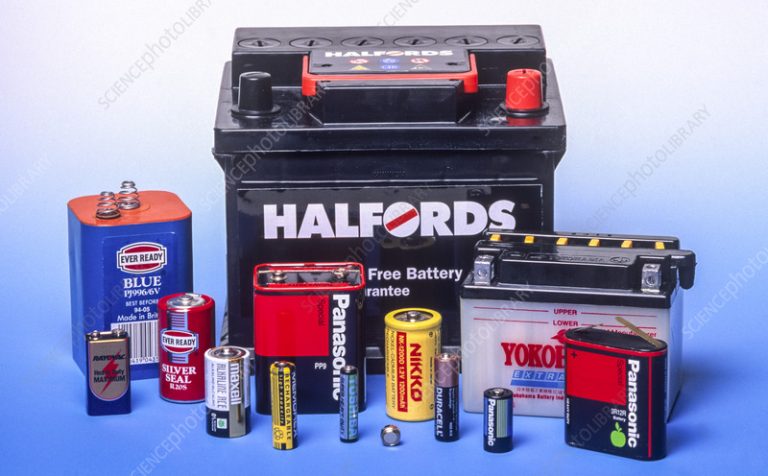
A battery stores chemical energy and changes it into electricity when you connect a circuit. Charging reverses the process.

Is electrical energy renewable or nonrenewable?

Neither, because electricity is a secondary source. Whether it counts as renewable depends on how a power plant made it: solar and wind are renewable, while coal and natural gas are not.

What is the SI unit of electrical energy?

The joule (J). Utility bills use the kilowatt-hour, and 1 kWh = 3.6 million joules.

How do you calculate electrical energy?

Multiply voltage by current by time (E = V × I × t), or power by time (E = P × t). For bills, use kWh = watts × hours ÷ 1,000.

Why is electrical energy important?

We can make it from many sources, send it hundreds of miles almost instantly, control it precisely, and turn it into light, heat, motion or sound. No other form of energy is as flexible.

Conclusion

To sum up, electrical energy is energy delivered by charge moving through a voltage, and you can calculate it with E = V × I × t. Remember the difference between energy (J or kWh) and power (W), convert your units first, and you can solve most energy problems, estimate what any appliance costs to run, and read your electric bill with confidence.

Keep learning: try our free electrical calculators. If you work in the electrical field or plan to, explore the electrical design consultancy course.

References

Similar Posts